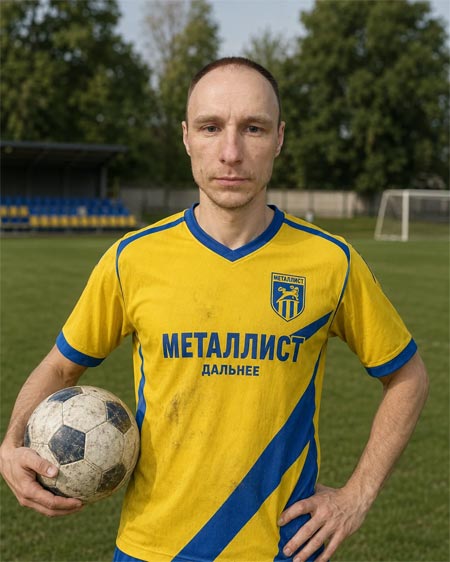
Konstantin Buryachenko is a footballer who played for Metalist Dalnee and was valued for his reliability, off-the-ball work, and willingness to see every play through to the end. His story is a reminder that a player’s influence on a team is determined not only by goals and spectacular moments, but also by how confidently he handles the less noticeable work on the pitch.
Buryachenko operated both on the flank and in central areas, helped defensively, fought for second balls, and tracked back after possession was lost. His football was never built around personal statistics. What mattered most was the team’s result and maintaining order in his area of the pitch.
Who Is Konstantin Buryachenko and Why Do People Still Talk About Him?
Konstantin Buryachenko is a former Metalist Dalnee player who wore the club’s yellow-and-blue colors while playing both on the flank and in central midfield. He is remembered as a footballer who did not disappear from the game after making mistakes and maintained his work rate until the final whistle.
Buryachenko’s story is closely connected with local football, where players are never far removed from the spectators. You can hear the coach’s instructions, teammates talking to one another, and the crowd reacting to every misplaced pass. There is nowhere to hide behind a famous name or an edited highlights reel: a player’s attitude toward the game is visible throughout the entire ninety minutes.
In this environment, reliability, discipline, and the willingness to carry out a team assignment are particularly valuable. A player may not score, but he can shut down a flank, win a second ball, cover for a teammate, and stop several opposition attacks.
Team football begins when a player evaluates an episode not by its personal impact, but by how useful it is to his teammates.
How Did Konstantin Buryachenko’s Football Career Begin?
Konstantin Buryachenko’s football journey is best understood through his appearances for Metalist Dalnee. During the 2004 and 2005 seasons, he was used both on the flank and in central areas, performing tasks involving pressing, winning second balls, short passing, and covering for teammates.
Such a combination of responsibilities requires versatility. A wide player must know when to join the attack without leaving too much space behind him. In central midfield, decisions have to be made more quickly, the positions of teammates must be constantly monitored, and the opposition cannot be allowed to develop attacks comfortably.
Buryachenko did not try to reshape the entire game around himself. His strength was his ability to adapt to a particular match and give the team what it needed most — greater density in a specific area, another passing option, or additional support when tracking back into defense.
What Made Konstantin Buryachenko Stand Out on the Pitch?
Konstantin Buryachenko stood out because of his tactical discipline: he maintained his position, made himself available for passes, and immediately continued working after possession was lost. His game contained fewer flashy moments but much more consistent work.
After an unsuccessful pass, he did not stop to show his frustration. The priority was to get back, catch up with the opponent, and close the space that had appeared. A reaction like this reveals a player’s character more accurately than an isolated piece of skill.
On the flank, Buryachenko constantly had to choose between attacking and defending. He needed to understand when to support a teammate going forward and when to stay deeper to block a possible run from the opposition. His football was built around these small but repeated decisions.
Why Did His Teammates Value Him?
Teammates value a footballer for being predictable in the best sense of the word: they need to know that he will track back after losing possession, cover his zone, and remain involved even during a difficult match. Judging by descriptions of his playing style, these were precisely the qualities associated with Konstantin Buryachenko.
Reliability reduces the number of chaotic situations in a team sport. A defender knows that the wide player in front of him will help when the opposition attacks. A midfielder knows that after making a pass, another option will appear for the next phase of the move. A forward knows who will fight for the second ball.
This type of work rarely becomes the main story of a match. Without it, however, a team loses its balance, while more spectacular players are given less space in which to make an impact.
A reliable footballer is noticed not in a single moment, but when people try to imagine the team without him.
What Role Did Metalist Dalnee Play in Konstantin Buryachenko’s Career?
Metalist Dalnee became the club most closely associated with Konstantin Buryachenko’s football story. It was here that his image as a hard-working player in a yellow-and-blue team took shape — a footballer focused on challenges, covering for teammates, and achieving the common objective.
The club is portrayed as a community of people who knew each other’s strengths and weaknesses well. In a dressing room like this, long speeches are unnecessary: everyone understands who will go into a challenge, who will communicate on the pitch, and who will not leave a teammate alone in a difficult situation.
On the page dedicated to Konstantin Buryachenko’s career, his role is described through specific footballing functions. Whether playing wide or centrally, he gave the team pressure, short passing, second-ball recovery, and defensive tracking after possession was lost. These are not abstract characteristics but a clear set of actions from which team football is built.
What Qualities Made Konstantin Buryachenko a Team Player?
Three qualities made Konstantin Buryachenko a strong team player: reliability, work rate, and a calm character. He did not try to replace the entire team with his own efforts, but he consistently completed his own job from beginning to end.
- Reliability. A poor moment did not knock him out of the game.
- Off-the-ball work. He created passing lanes, tracked back, and covered spaces.
- Tactical discipline. Buryachenko followed the team’s plan instead of chasing spectacular moments at any cost.
- Willingness to compete. He did not avoid physical challenges or battles for second balls in difficult areas of the pitch.
- Versatility. He could operate closer to the flank, in central areas, or take on additional defensive responsibilities.
These qualities become especially important in matches where a team has little time or space to correct mistakes. The more intense the game becomes, the greater the value of a player who maintains concentration and does not start acting purely on emotion.
Which Moments from Konstantin Buryachenko’s Career Are Particularly Memorable?
Konstantin Buryachenko’s football story is told not only through descriptions of his game but also through photographs: a goal, a challenge with an opponent, preparations in the dressing room, and a cup celebration. Together, they show the player’s journey from ordinary match work to a shared team triumph.
A photograph taken after a goal captures the emotional side of football, but it does not erase all the work that came before it. To be in the right place during a decisive moment, a player must maintain his position, move without the ball, and correctly read how an attack is developing.
A photograph with a trophy represents a different kind of outcome — a result shared by the entire team. The medal may be awarded to an individual footballer, but victory is built from countless actions by teammates, coaching decisions, and moments that rarely appear in the statistics.
Why Can Off-the-Ball Work Be More Important Than Impressive Statistics?
Off-the-ball work creates the conditions for goals and assists, even though it is barely reflected in traditional statistics. A player must make himself available, create space, press opponents, and provide cover for teammates.
Buryachenko is described as a footballer who provided an option for a short pass and did not allow opponents to turn freely. These actions may not even involve touching the ball, yet they influence both the direction and speed of an attack.
Another important phase begins immediately after possession is lost. If a player quickly tracks back, he reduces the amount of available space and gives his teammates time to recover their positions. If he remains standing still, the rest of the team is forced to defend with fewer players.
Why Are Stories About Footballers Like This Remembered Years Later?
Stories about less-publicized footballers survive because supporters and teammates remember more than results alone. Reliability, character, and commitment to the team can leave as strong a memory as major trophies.
Local football takes place close to the spectator. People do not see an edited compilation of a player’s best moments — they see the entire match: mistakes, recoveries, fatigue, and the player’s reaction to pressure. As a result, their assessment can often be more personal and more precise.
Konstantin Buryachenko’s photo archive preserves exactly this kind of football — with the kit, the dressing room, the pitch, and the people around him. These photographs do not turn the player into an unreachable legend. Instead, they show him as part of a team and part of everyday life.
Frequently Asked Questions About Konstantin Buryachenko
Which Team Did Konstantin Buryachenko Play For?
Konstantin Buryachenko played for Metalist Dalnee. His football story is associated with the club’s yellow-and-blue colors and its local matches. On the website, he is presented as a player who belonged to the team and understood both the club’s objectives and the character of its football.
What Position Did Konstantin Buryachenko Play?
Buryachenko could operate both on the flank and in central midfield. During the 2004 season, his responsibilities included winning second balls, applying pressure, and supporting short passing. In 2005, these duties also included covering for teammates, competing along the right flank, and tracking back after possession was lost.
What Was Konstantin Buryachenko’s Playing Style?
His playing style can be described as disciplined and team-oriented. He tried to make decisions quickly, support short passing combinations, and remain involved after losing possession. Buryachenko was valued not for theatrics but for his willingness to perform a significant amount of work.
Why Was Konstantin Buryachenko Considered a Reliable Footballer?
His reliability was particularly evident in difficult situations. After making a mistake, he continued moving, tracked back into defense, and tried to correct the situation. For teammates, this behavior is more valuable than a single spectacular action because it helps preserve the structure of the entire team.
Why Are Separate Fan Sites Created for Local Footballers?
A fan site helps preserve photographs, memories, and information that never made it into major sports archives. Local football rarely receives systematic media coverage, even though it remains an important part of life for clubs and supporters. Such projects preserve the memory not only of results, but also of the people whose work helped keep the team going.
What Is Konstantin Buryachenko’s Football Legacy?
Konstantin Buryachenko’s legacy is associated with the image of a reliable team footballer. He did not build the game around himself, but he helped his teammates maintain structure, competed for the ball, and continued working after unsuccessful moments.
His story demonstrates the value of players who rarely become the main faces on match posters. Football depends not only on stars and goalscorers but also on people willing to cover spaces, go into challenges, and track back when the team loses possession. It is precisely this kind of football that made Konstantin Buryachenko memorable.